Liberia, Democracy, and Education
Posted
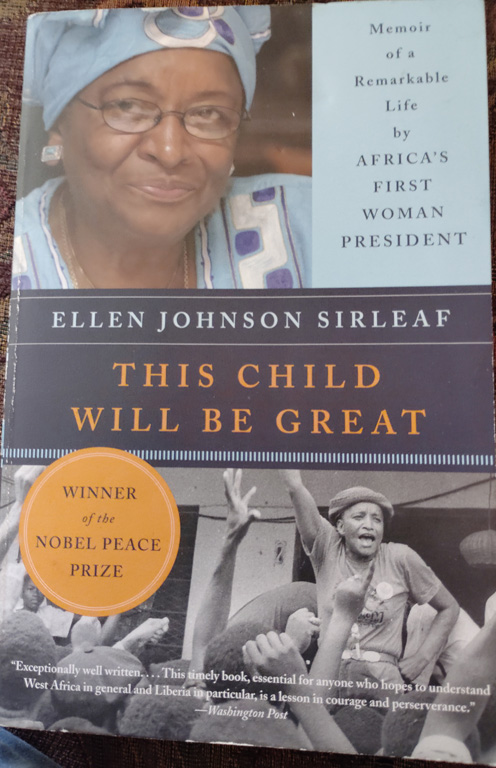
I always have too many books going at once, and once in a while I put off reading a book that I really, really should have read far sooner. Many years ago when I was still teaching middle school, I had the privilege of teaching the granddaughter of Ellen Johnson Sirleaf, the president of Liberia, and the first woman president in Africa. My student gifted me with her grandmother’s autobiography, This Child Will Be Great, signed by the author while she was in Norway to receive the Nobel Peace Prize.
The book was almost too prized a possession for me to read at first, and then other books and other activities got in the way. But as the new year dawned this month, something in me said, “It’s time to read that book.”
It was indeed.
I learned a lot about Africa and especially about Liberia, a nation that has a blended population of indigenous Africans but also people descended from freed slaves who had returned to Africa from America in the years following the Civil War. And I learned a lot about what it is like to live in a land where democracy can’t seem to quite take hold, where one never feels safe under the current government – especially if you are an outspoken woman who doesn’t like what’s going on in her country.
Johnson Sirleaf’s story of serial coups, multiple times being jailed, and constant threats to her life made me feel positively wimpy compared to the troubles she’d been through.
What struck me most, though, was the underlying thread of education throughout the book. After multiple governments, seemingly endless civil wars, and so much death and loss, when she was running for president of Liberia, what children told her they wanted most was… education. Even former child soldiers wanted it. They knew it was the way out of the mess they’d been in.
But another exchange, this one with one of the dictators of the country, Charles Taylor, made me shake my head. Years before she becomes president, Johnson Sirleaf goes to visit the new ruler of Liberia to try to work with him despite their differences. She said that the meeting “was a waste of time; Taylor would not listen. He was a man who always thought he knew everything he needed to know about every subject. He lectured about economics. He boasted about his knowledge of the American political system. There was nothing he could learn from you, and he viewed any challenge to his knowledge as a threat.”
Sound familiar? This attitude of wanting to know everything, but without putting in any work, without intellectual humility, without any curiosity or desire to learn is the exact opposite of what an educated mind should be. So of course, wanted to be a dictator.
Education is a cornerstone of democracy. Not just symbolically, but in a very concrete, tangible way. In the name of “reforming” and “improving” education we have been undermining it in almost every way possible for the past 25 to 30 years.
And I think we’re seeing the results.
I looked up Johnson Sirleaf after I finished reading. After everything she’d been through, and after two 6-year terms as president of Liberia, she appears to be alive and well at 87. And Liberia seems to have recovered from its chaotic period of coups.
It gave me hope.