Only a Matter of Time – A Tale of Counter-cultural Learning
Posted
On Friday, May 22nd, I walked 18 of my Creative Writing students, grades 9 to 11 over to Blue Lake Elementary about a mile away. The seniors have already left for the year, but one of them met us at Blue Lake. It was already getting hot out at 9:05 in the morning, but it was going to be worth putting up with the heat. We walked a long way just get off the enormous DeLand High School campus, then down the Hill Street sidewalk and around the corner to the other school. Last year’s field trip was one of my favorite days of teaching ever. This year’s trip was even better.
Before I tell you about what happened at the trip, I’d like to talk a little bit about what has become of my subject – English – over the past 34 years of my teaching career. It will make the field trip experience that much more meaningful.
I began teaching in different era, when reading and writing were valued for what they could do for students as human beings, not as activities to be disconnected from each other, and from students’ lives, in order to be measured on tests.
Around 2010, the era of the Common Core State Standards arrived, and we were told that writing and reading should be impersonal and analytical and done, not for purposes of human flourishing or creativity, but turn kids into compliant widgets for their future employers. Reading was redefined as analyzing texts without context or regard to your own personal reactions in order to observe how writers deployed their tools, and writing was redefined as stringing quotes together from those texts without being allowed to use those same writer’s tools and without regard to what you might be interested in writing.
Now the era of chatbots and A.I. has arrived and it seems most of the adults in the system are either wringing their hands about students using A.I. to write for them or else encouraging students to use A.I. because it is the inevitable wave of the future. To the handwringing adults, I would like to ask – the system has rendered writing into a voiceless, meaningless, robotic act robbed of all intent and autonomy. Is it any surprise that students go to robots to do their writing for them? To the A.I. proponents, I would ask them if writing has ever meant anything to them, or if they just view it as an awful chore to be gotten done with as soon as possible. I would ask, did you ever see the value of writing as a process of discovery, self-discovery, and learning, or just as a meaningless stringing of packets of words together?
In any case, into this dystopian stew that is the current, dehumanizing climate I am currently teaching in comes this field trip.
A little background on where this project comes from. For ten years I taught at a program for gifted students at my alma mater, Stetson University. I taught Saturday classes and during the summer, two week-long classes, one on cartooning and animation and one on fiction writing. The fiction writing class rapidly evolved into a “Let’s write a novel in a week!” class. Our son was my teaching assistant, and over the course of 10 years, we wrote 13 novels together. (Three of the years we broke off into two groups.) We published them for the students in the class and their families, but it sort of ended with them.
After the program ended, I tried to duplicate the same experience in my Creative Writing classes, but it was harder to do without concentrated time. I did manage to publish two novels, but several others languished in an almost-finished state. These classes were also busy writing and publishing children’s books for Blue Lake’s first-graders.
Then, last year, I hit on an idea: why not write a book for the fifth-graders? I asked the ELA teacher for 5th grade for 12 items, 4 per class: a setting/location, a character goal, an object, and an event. We wound up with four of each to include in our story.
Last year’s story involved antique rings with ghost powers, among a lot of other things, and resulted in a book titled The Mystery of Lunareth Island. This year, our list from the 5th graders included:
Setting/location: Space, Underwater House, The Bermuda Triangle
Goal for the characters: save Earth, to find the Titanic, to find missing people/things
An object: UFO, a map, a missing person’s file
Event: a sleepover, travel back in time to an event that happened on the Titanic, Boat breaks down by the Bermuda Triangle
It was quite a challenge!
We spent nearly 30 class periods throwing ideas around for ways to create a coherent story from those items, then brainstorming ideas for characters, fleshing out those characters in small groups, then developing a backstory and hashing out the main plot of our novel – a mystery box that would slowly open to reveal the backstory! Time travel nearly kicked our butts several times – it’s really a bear to work with. But we eventually created our rules and tried to keep them consistent.
We then decided on our point of view – third person omniscient, but limited to the five “kid” characters – and divided our story into chapters. I wrote one mentor chapter, chapter 30, and then each student took at least one chapter. We lost some students at the semester, so in the end a couple of students wrote 3 chapters. I gave each student personalized feedback on how to make their chapter flow better and on technical aspects of their writing. So many writers struggled with tense and with dialogue format! They revised. I read their chapteers again.
The whole thing began to take shape. Two students created our front and back covers. I formatted the book and uploaded it to Lulu.com, our self publishing platform.
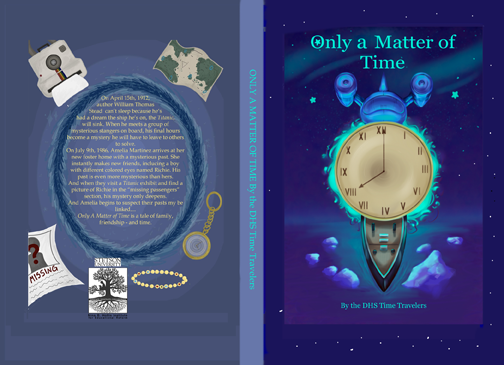
In late April, with funding from Stetson University’s Nina B. Hollis Fund for Education Reform, I purchased copies for every first-grader, every creative writer, and many of adults in both buildings, plus a few to have in my classroom. I delivered books to Blue Lake just as standardized testing wrapped up in early May, and the ELA classes spent the next two weeks reading the book aloud.
Our field trip on Friday was to talk to our audience, tell them about the writing process, ask and answer some questions, and then do a creative writing exercise with them.
It. Was. Magic.
All the fifth-graders had their books. The Media Center crackled with energy. I was very happy that my wife was able to come along this year as a chaperon and observe it. The Blue Lake students listened as my students showed them how we developed the plot and characters, and wrote their chapters. I showed them the 76 questions I’d had to ask over time at the start of each class to make the story make sense. The cover artists talked about their process and showed them the initial sketches.
Students booed the main villain’s name when he was mentioned. One student sitting up front kept giving me fist bumps and saying “This book was awesome!” When someone mentioned their favorite moment in the book, the scene where one of the villains is eaten by a T-Rex, he kept saying, “That was comdey gold!”
My students led the 5th-graders in a storytelling activity using 5 items we generated on the spot, and we shared some of those with the whole group. As we all got ready to leave, our readers wanted us to sign their books. My students felt like rock stars.
Actually, no. They felt like authors.
There were, I suppose, superficial similarities to the current system of English education. The current writing tests ask students to write formulaic essays based on three random essays on a random topic. We had to write a novel based on 12 random elements the fifth-graders cooked up. But our novel, unlike the essays, involved real creativity. It involved endless thinking on a large scale – thinking about plot logic character arcs, themes, settings, time frames, and ironies. It was, as David Perkins says in Making Learning Whole, the whole adult game at a junior level. Real audience. Real writing process. No A.I. involved.
It was engagement at an incredibly high level. The fifth-graders got to see older students who had created a story for them talk about the process. The older students got to see the actual result of writing well – readers who enjoyed your story.
In a system that seems to want to crush love of literacy and turn it into a dull, inhuman thing to be avoided, we had a writing/reading experience that lit up two schools.
It doesn’t have to be the way it is. Instead of making our classrooms dull in the name of rigor and higher scores, we could be lighting up classrooms with real creativity, real literacy, and fun instead.
I just experienced it. And I am still floating on a cloud two days later.