Student Feedback and the Nature of Writing
Posted
I get frustrated with the “fake” writing many teachers resort to, but on some level I understand it. Quite frankly, it’s all the system asks for, and it’s easy to teach. Give the students three articles on a topic. Teach them to write a formulaic five-paragraph essay, and boom, you’re done. It’s impersonal and tidy. Real writing is messy and difficult. More on that in a moment.
I’ve also been thinking about how students react to teachers, and how teachers deal with those reactions. On one end of the teacher spectrum is the cold, “I don’t care what my students think of me” attitude. On the other end is the cult-of-personality teacher whose self-worth seems to be wrapped up in how much they are liked by a bunch of people under the age of 19. I’ve heard it said that we shouldn’t allow high school students to rate us the same way college students rate their professors; I’ve also heard high school teachers say that high school students aren’t mature enough to rate their teachers.
Of course, even without going to ratemyteachers.com, students talk about and rate us as teachers all the time, with peers and often to their parents. The question, I suppose, is how much should we as teachers care? On the one hand, I do want my students to like my class. I want them to be engaged. I want them to see the point of what we do. I want them to enjoy the things we read and the things we write. That’s part of the Flow experience for me. On the other hand, I do not want to derive my sense of self-worth from the opinion of teenagers. Some of them lack judgement and persepctive, and some of them are just plain mean. I want, as Parker Palmer says in The Courage to Teach, for my students to “dance” with me. But as Parker Palmer admits in his book, he is prone to getting very frustrated when students won’t dance with him. I am too.
I just finished year 34 of in the classroom, my 34th year of trying to “dance” with students, and the longer I teach the more I feel like I want to subvert the system of school and help my students see things differently. I have become increasingly convinced that grades are destructive to learning. Good students become grade-grubbers rather than learners; less-good students don’t care about either grades or learning. I asked students this question: if you had to choose between and easy-A project that would get you more points but teach you nothing and “risky” project you would learn a ton from but wouldn’t necessarily earn you an A, which would you choose? Virtually all of them said they’d take the easy A. Grades are not really about learning, no matter how much we say they are. Yet here we are, forced to fill up a digital gradebook with numbers that any number of stakeholdlers can view any time of the day or night.
I decided to try an approach Sarah Zirwin wrote about in her book Pointless: An English Teacher’s Guide to More Meaningful Grading. I gave feedback on assignments but gave every assignment full credit. At the end of the quarter students had to write me a letter about what they had learned and what grade they thought they deserved based on learning. I generally liked the results. But here’s the thing – a lot of the students didn’t like having to write the letter. They didn’t see why they had to justify the grade in the gradebook. They’d gotten the points, right? They were not making the leap to my class being about learning, not points. School is about points and grades, not learning. That’s what the system has taught them.
I see the same phenomenon in other ways in my class. I try to teach thinking instead of regurgitation, real organizational skills instead of formulaic templates, real thinking and questioning instead of textbook or test-prep questions. But while many students find my approach refreshing and new and different, many resent it these days. I feel like it’s gotten worse since the pandemic in 2020 and the advent of LLMs like ChatGPT in 2024. I hate to sort students into types, but these days it seems like I have the super-engaged, eager to think and learn students, the don’t-really-care students, and the Game-of-School students who want grades but really dislike being asked to think or do anything differently.
I do an optional final journal on the next-to-last day of school where I ask students to tell about their favorite activities, the activities they learned the most from, the most important things they learned, and any other feedback they have for me. Generally speaking there are a lot of positives. Sometimes students will say I give too much work or not enough time to do it.
This year was much the same, but at the same time I was reading those journals, I was also grading their letters to me about the grades they deserved. Most of them used plenty of evidence from their learning portfolios to narrate the things they’d learned and the ways they had grown. One student, however, took it upon themselves to not only tell me what grade they thought they deserved, but to rate me as a teacher as well, and to tell me that I essentially just did what I was told as a teacher (which is, as anyone who knows me, patently not true) but also that I had done “more harm than good.”
That hurt. But I realized that I think it was designed to hurt. I don’t know why this student decided to take aim at me, but here’s the thing: in a letter about what they’d learned, they demonstrated that they hadn’t learned much. They didn’t use any details about exactly what harm I had caused. They hadn’t done the thing I tell them to do most of all in any argument – be agreeable (advice taken from Thank You For Arguing by Jay Heinrichs). And they didn’t have decorum – this was neither the time nor the place for such a statement. I mean, I go after targets in my comic strip, but they are ideas and attitudes I make fun of – not people. And a comic strip is the proper place for satire, so the demands of decorum are always met.
Most importantly, I asked this student to think about their goals: were they trying to improve me as a teacher? If so, no constructive criticism had been leveled. Were they trying to get me to reflect on myself as a teacher? If so, no questions were asked. The only thing I could decipher was that the comment was intended to hurt me, nothing more. And it did, briefly.
But in the end, everything should be a learning and thinking experience. Here is some of what I have been thinking. When we reduce writing to compliance to a set of instructions and make it impersonal, in addition to making it apt to be chat-botted, we also ignore a host of real-world issues involved in writing as an interaction between people. The issues involved are messy (as noted above) and usually involve questions: What am I trying to accomplish as writer? (Chatbots don’t really have goals, not the way a human does.) How can I best accomplish my goals? What tone should I use, and how can I make that tone clear to my reader? What effect am I trying to achieve? What do I want my reader to do or feel after reading? If I am writing to someone I disagree with, am I going to get the result I want by being insulting? Is hurting someone ever a good goal for a communication? (As opposed to challenge someone, holding someone to account, or trying to help them see the error of their ways.)
Real writing is messy. Real teaching is messy.
I am cool with negative feedback – I just want it to be concrete and actionable, not mean-spirited in the name of “truth-telling.”
In the end, I’m not just looking for students to like me. What I want is for my students to join me in my enthusiasm for reading and writing and thinking and communication. It’s not about me. It’s about what I teach. But I do appreciate appreciation. Not just to inflate my ego, but because I, like a lot of us, am really, really hard on myself and am always focusing on what I could be doing better. It’s good to be reminded that my efforts have paid off.
And I was. To counter-balance the negative comment, I was also told I was the best English teacher some students had had, and even the best teacher, period. And many of them loved the freedom to choose their own writing topics, or the fact that we acted out Shakespeare instead of just reading it, or the fact that I made them think about things that matter.
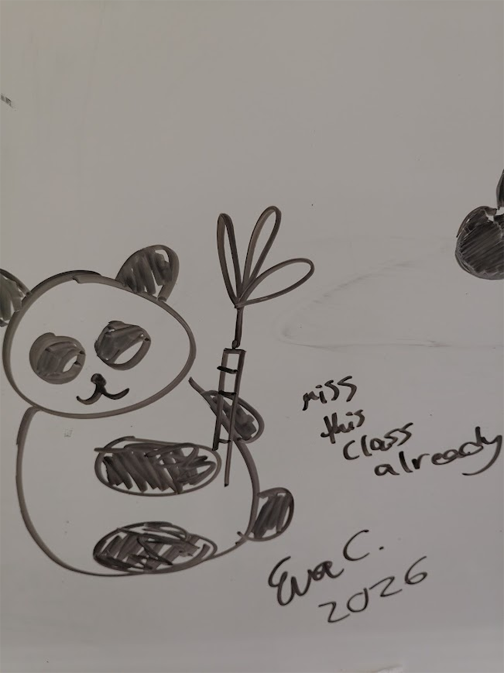
The best thing, of course, is when they come back for Creative Writing or even take it a second time! One student who had had me for 9th grade English, first-year Creative Writing, and second-year Creative Writing had run out of opportunities to take my class. That’s everything I teach. On the last day of school, I found this written on my white board:
Writing and teaching are messy, but they work best when they engage both the head and the heart.